 StableGold

Beyond Stablecoins: Why Precious Metals May Be the Next Major Real-World Asset Market
Gold is already emerging as the dominant tokenized commodity. The next stage will depend on connecting physical reserves, financial trust, regulatory compliance, and blockchain infrastructure across the asset’s complete lifecycle.
From Stablecoins to a Broader Tokenized Economy
Stablecoins provided the first major demonstration that blockchain infrastructure could support internet-native financial products at meaningful scale.
They showed that digitally represented value could move across global networks with greater speed, programmability, and accessibility. They also created a settlement layer that made it easier for participants to transact, deploy capital, and interact with financial applications onchain.
The tokenization conversation has since moved beyond payments.
Government securities, money-market funds, private credit, commodities, equities, and other financial assets are increasingly being issued, recorded, or represented through blockchain-based infrastructure. According to a market analysis published by a16z crypto in May 2026, the non-stablecoin tokenized asset market had recently crossed $30 billion and was approaching $34 billion—up from less than $3 billion in mid-2024.
The market remains very small relative to the scale of global finance. Yet its growth suggests that tokenization is progressing beyond isolated pilots and into a new stage of market development.
Within that evolution, precious metals—and gold in particular—stand out as one of the clearest early use cases.
The tokenization market is moving beyond digital cash. The next phase is about bringing established financial and physical assets into programmable digital markets.
Gold Is Already Leading the Tokenized Commodity Market
The emerging tokenized commodities category is not broadly distributed across oil, agriculture, energy, and metals. It is overwhelmingly concentrated around gold.
As of the May 2026 market snapshot examined by a16z crypto, gold-related products represented approximately $5 billion of a roughly $5.1 billion tokenized commodities market. Silver-related and other commodity products accounted for only approximately $57.6 million, equivalent to around 1.1% of the category.
This degree of concentration is significant.
It suggests that the market is not tokenizing every commodity at the same rate. Instead, it is converging first around an asset with many of the characteristics required for effective digitization and onchain distribution.
Gold is:
- globally recognized;
- durable and non-perishable;
- supported by mature refining and professional custody infrastructure;
- traded through established international markets;
- capable of being independently weighed, verified, and valued;
- and already commonly owned through custodial or financial claims rather than direct possession.
These characteristics make gold particularly compatible with tokenization.
Existing tokenized gold products have already demonstrated that rights or claims connected to physical gold held in professional vaults can be represented through blockchain-based instruments and held in digital wallets. This translates a familiar form of gold ownership into infrastructure that can support digital transfer, automated controls, and interaction with broader onchain markets.
Gold also occupies a distinctive place in the digital asset narrative. Long before tokenized gold products gained traction, bitcoin was frequently described as “digital gold.” Both assets are associated—through very different structures—with scarcity, independence from discretionary monetary expansion, and their potential role as stores of value.
Tokenized gold forms a bridge between these two financial worlds: the established trust and physical scarcity of precious metals and the portability and programmability of digital financial infrastructure.
DATA VISUAL 01
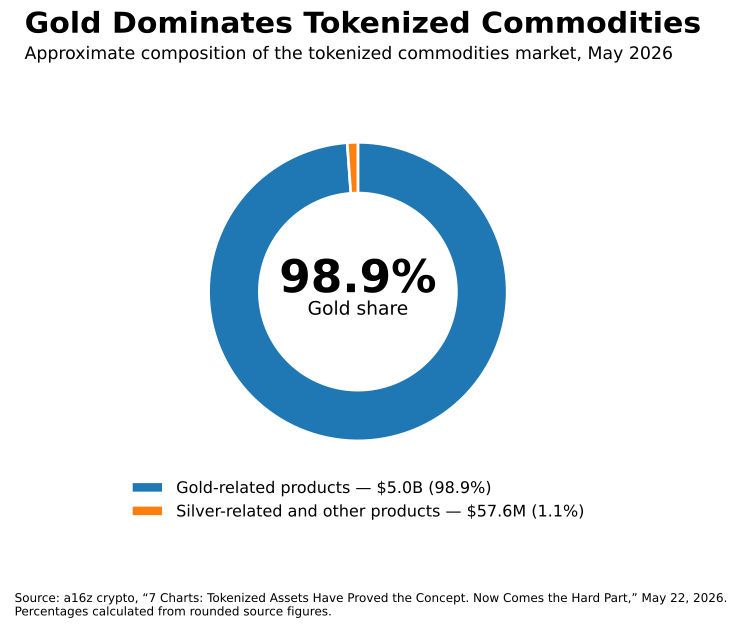
Approximate market composition based on an a16z crypto market snapshot published on May 22, 2026. Percentages are calculated from the figures reported in the source and may not sum precisely because the reported market values are rounded.
Early Traction, Enormous Headroom
The approximately $5 billion represented by tokenized gold is meaningful within the developing RWA market, but it remains extremely small in comparison with the underlying physical gold market.
The total value of above-ground gold is measured in the tens of trillions of dollars. Based on the May 2026 data, tokenized gold represented less than 0.02% of that broader market.
This contrast offers a more useful interpretation of the opportunity.
The significance of tokenized gold is not that it has already captured a substantial portion of the global gold market. It is that a functioning category has emerged despite the market still being at a very early stage.
The concept has progressed from theory to market activity. There are now recognizable issuance structures, professional custody arrangements, blockchain-based ownership records, digital distribution channels, and investors willing to hold gold-related value through onchain instruments.
That does not make the market mature. It demonstrates that the foundations of a market are beginning to form.
Tokenized gold is already large enough to validate the concept—and still small enough to reveal the scale of the opportunity ahead.
The next stage will require more than simply increasing the number of tokens in circulation. It will require improved distribution, clearer legal structures, greater reserve transparency, reliable redemption processes, and deeper integration with digital financial applications.
Why Gold Makes Sense Onchain
Tokenization does not change the physical nature of gold. Nor does it remove the need for vaulting, insurance, verification, legal documentation, or trusted market participants.
What it can change is the infrastructure through which ownership is represented, transferred, verified, and used.
Traditional exposure to physical precious metals can involve fragmented processes across dealers, refiners, logistics providers, custodians, insurers, auditors, financial intermediaries, and settlement systems. These functions remain essential, but the resulting ownership experience can be difficult to integrate into modern digital markets.
Blockchain infrastructure introduces the possibility of a shared digital representation that connects these processes.
When structured appropriately, tokenized precious-metal products can support:
- digitally transferable ownership;
- fractional access to larger physical reserves;
- transparent issuance and supply records;
- automated transfer and compliance controls;
- integration with institutional custody and digital wallets;
- faster movement across approved financial networks;
- and potential use within lending, collateral, treasury, and settlement applications.
The opportunity is therefore not simply to place an existing gold claim on a blockchain.
It is to improve how the physical asset interacts with digital financial markets while preserving the controls, rights, and safeguards that make the underlying ownership credible.
This distinction becomes particularly important as onchain markets evolve from holding tokenized assets to using them as programmable financial building blocks.
Current data suggests that precious metals remain primarily held onchain rather than extensively deployed across decentralized financial applications. In other words, much of the market has achieved digital representation and transferability, but not yet full financial composability.
That gap defines the next phase of development.
The long-term opportunity is not merely to digitize gold ownership. It is to enable precious metals to participate more fully in modern financial markets.
A Multichain Market Is Taking Shape
Although the tokenized commodity category is concentrated around gold, the blockchain infrastructure supporting the tokenized asset market is more diversified.
In the May 2026 market snapshot:
- Ethereum hosted approximately $15.7 billion in tokenized assets;
- BNB Chain hosted approximately $4.0 billion;
- Solana hosted approximately $2.2 billion;
- Stellar hosted approximately $1.7 billion;
- and Liquid Network hosted approximately $1.5 billion.
The XRP Ledger, ZKsync Era, and Arbitrum were each approaching $1 billion.
Ethereum continued to hold slightly more than half of the market measured in the analysis, reflecting its early position in decentralized finance, established technical standards, broad wallet support, and growing institutional adoption.
The distribution across other networks, however, indicates that the market is unlikely to converge around a single blockchain.
Issuers and financial institutions may select networks according to different requirements, including:
- security and resilience;
- liquidity;
- transaction costs and performance;
- institutional custody support;
- compliance functionality;
- investor and partner accessibility;
- interoperability;
- and distribution relationships.
The future of tokenized assets may therefore be multichain—but it must also be operationally connected.
For tokenized precious metals, selecting a blockchain is only one part of the architecture.
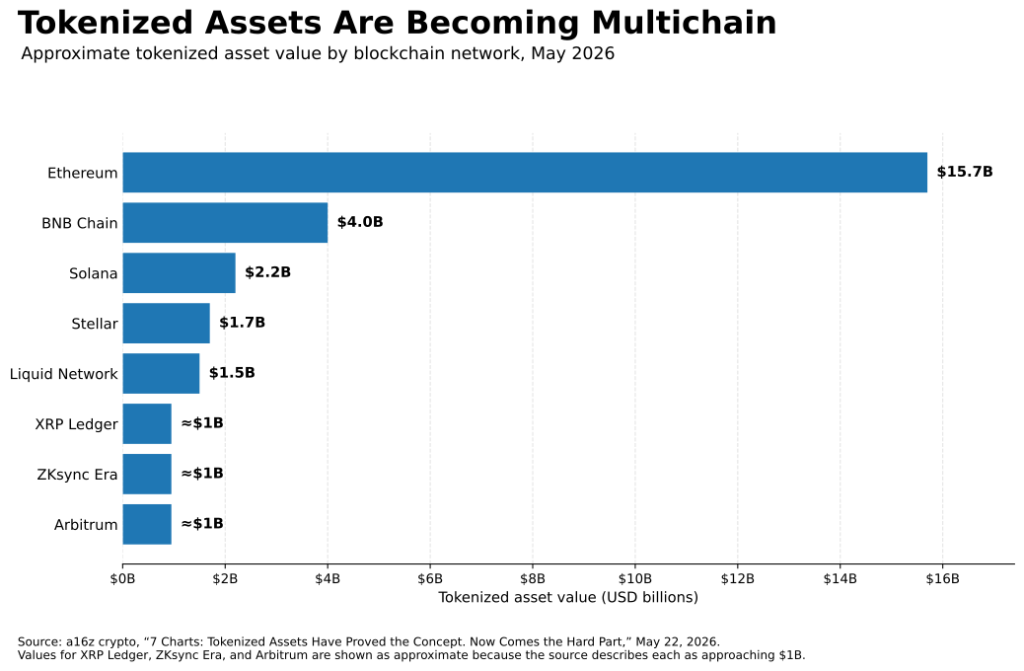
Approximate network distribution based on an a16z crypto market snapshot published on May 22, 2026. Values represent the tokenized asset market measured by the source and exclude stablecoins.
Token Creation Is Not the Same as Financial Infrastructure
A credible tokenized gold product depends on far more than the creation of a smart contract or the minting of digital tokens.
It depends on the integrity of the entire asset lifecycle:
- physical sourcing;
- refining and quality verification;
- professional vaulting;
- insurance;
- legal structuring;
- reserve allocation and reconciliation;
- independent verification and attestations;
- controlled issuance and burning;
- compliance and eligibility processes;
- secure distribution;
- transferability;
- liquidity pathways;
- and redemption.
Each token must be connected to a clearly defined physical and legal reality.
Weakness in any part of that lifecycle can undermine confidence in the entire product. Blockchain transparency cannot compensate for uncertain title to the underlying metal, inadequate custody arrangements, unverifiable reserves, weak issuance controls, or unclear redemption rights.
This is where the distinction between token creation and financial infrastructure becomes critical.
Building the StableGen Standard
StableGen is building the physical and digital infrastructure required to support the complete lifecycle behind the tokenization of gold and other investment-grade precious metals.
The objective is to establish an institutional-grade standard through which physical metals can be sourced, held in professional custody, represented onchain, independently verified, distributed through compliant channels, transferred across modern financial networks, and redeemed through clearly defined pathways.
This requires connecting the established precious-metals supply chain with proprietary tokenization infrastructure and an ecosystem of professional service providers.
The StableGen model is designed around four interconnected layers:
Physical reserve infrastructure
Investment-grade precious metals sourced through established industry participants and held through professional custody arrangements.
Digital issuance infrastructure
Controlled issuance designed to maintain correspondence between the digital assets in circulation and the physical reserves supporting them.
Transparency and verification infrastructure
Reserve records, reconciliation processes, independent attestations, and disclosures that allow participants to evaluate the integrity of the backing arrangements.
Distribution and lifecycle infrastructure
Compliant pathways for access, transfers, ecosystem integration, and redemption, subject to product terms and jurisdictional requirements.
StableGen’s ambition extends beyond issuing an individual token. It is to build the commodity reserve layer that allows precious metals to function as programmable financial assets within the next evolution of the onchain economy.
Through this architecture, metals can move beyond passive ownership and begin to support new forms of digital collateral, liquidity, settlement, and financial utility.
StableGen’s wider infrastructure vision and operating model are outlined in We Are StableGen.
The StableGen Standard connects physical reserves, financial trust, and blockchain infrastructure across the complete lifecycle of a tokenized precious-metal asset.
Regulation Is Beginning to Catch Up
Tokenized assets are not developing outside the regulated financial system.
Across major jurisdictions, the central policy question is increasingly shifting from whether assets can be represented on blockchain networks to how those representations should operate within existing legal and regulatory frameworks.
United States
In the United States, policy discussions have increasingly focused on enabling established financial assets to benefit from blockchain-based recordkeeping, issuance, transfer, and settlement.
The legal character of an asset does not disappear when it is placed onchain. In January 2026, the US Securities and Exchange Commission’s divisions of Corporation Finance, Investment Management, and Trading and Markets published a joint statement explaining that a tokenized security remains a financial instrument subject to federal securities laws. The statement also distinguished between issuer-sponsored tokenization structures and several forms of third-party tokenization.
The principle is important beyond securities: tokenization changes the format and infrastructure through which rights are represented, but it does not automatically change the nature of those rights or remove the applicable regulatory obligations.
European Union
The European Union has developed a more structured framework through a combination of MiCA and existing financial-services legislation.
MiCA establishes uniform European rules for crypto-assets that are not already regulated under other EU financial-services frameworks. Its requirements include transparency, disclosure, authorization, governance, and supervision provisions for relevant issuers and crypto-asset service providers.
MiCA should not, however, be treated as the single legal framework for every tokenized real-world asset.
A token that qualifies as a financial instrument may instead fall within MiFID II and other established capital-markets rules. ESMA’s guidelines apply a technology-neutral, substance-over-form approach: where a crypto-asset provides rights equivalent to shares, bonds, or other transferable securities, it should be treated according to the relevant financial-instrument framework.
The relevant regulatory treatment therefore depends on the legal rights, economic characteristics, issuance structure, and intended use of the particular product—not merely on the fact that it references a physical asset or uses blockchain technology.
Across both markets, the direction is becoming clearer:
Tokenization does not replace financial regulation. Sustainable tokenization connects technological innovation with legally enforceable rights, credible reserves, appropriate controls, and reliable investor protections.
For precious-metals products, this means that scale will depend on more than technical functionality. It will also require legal clarity, appropriate authorization, compliant distribution, transparent disclosure, professional custody, reserve verification, and operationally dependable redemption arrangements.
The Next Stage of Tokenized Precious Metals
The tokenization of precious metals should not be viewed merely as a niche digital asset experiment. It is part of a broader transformation in financial-market infrastructure.
Assets are becoming more digitally accessible, transferable, interoperable, and programmable. Gold is particularly well positioned within this transition because it combines institutional familiarity, global recognition, established physical infrastructure, and a clear digital ownership use case.
The early data shows that gold has already become the dominant tokenized commodity.
But market leadership at this stage does not mean that the infrastructure challenge has been solved.
The next stage will be defined by whether tokenized gold and other precious metals can evolve from digitally represented assets into trusted financial instruments and programmable commodities capable of operating across modern financial markets.
That will require:
- stronger connections to the physical supply chain;
- institutional-grade custody and controls;
- transparent reserve verification;
- legally enforceable product structures;
- compliant global distribution;
- reliable liquidity and redemption pathways;
- and interoperability with the broader digital financial ecosystem.
The long-term winners will not be those who merely place a token on a blockchain.
They will be those who build credible infrastructure around the asset—connecting physical reserves with digital ownership throughout the complete lifecycle.
Physically Backed. Digitally Native.
StableGen is building the infrastructure layer that enables investment-grade precious metals to function as programmable financial assets for modern markets.
By connecting physical commodity reserves, institutional controls, and blockchain infrastructure, StableGen is establishing a new standard for transparent, verifiable, and scalable digital precious-metal products.
Sources and Further Reading
- a16z crypto — “7 Charts: Tokenized Assets Have Proved the Concept. Now Comes the Hard Part.” Published May 22, 2026. Market-size, commodity-composition, network-distribution, and utilization data used in this article.
- a16z crypto — “It’s Time to Bring Assets Onchain.” Published February 4, 2025. Policy commentary on tokenization and US financial-market infrastructure.
- US Securities and Exchange Commission — “Statement on Tokenized Securities.” Published January 28, 2026. Regulatory taxonomy and treatment of tokenized securities under US federal securities laws.
- European Union — Regulation (EU) 2023/1114 on Markets in Crypto-Assets. The EU’s harmonized framework for crypto-assets not otherwise covered by existing financial-services legislation.
- European Securities and Markets Authority — Guidelines on the Conditions and Criteria for the Qualification of Crypto-Assets as Financial Instruments. Guidance on applying a substance-over-form and technology-neutral classification under MiFID II and MiCA.
- StableGen — “We Are StableGen.” StableGen’s vision for connecting physical precious metals, institutional trust, and blockchain infrastructure.